 |
 |
|
|
| DEPARTMENTS | |||

|
|||

|
|||

|
|||

|
|||

|
|||

|
|||

|
|||
| YOU CAN!... | |||
|
|||

|
|||
|
|||
|
|||
| MORE ABOUT HUNGER NOTES |
|||
 |
|||

|
|||

|
|||
|
|||
|
|||
|


|
2010 Asia
|
|

Ravindra Misal--leading the revolution in Umred, a small Indian town. The NYT reporter came to the town to write about a riot, and he discoverd Misal. A few months earlier, power blackouts that rural Indians always suffered silently triggered a violent reaction in Umred. Why? Umred was just another small town in the middle of nowhere, dusty and underwhelming. But Umred had begun to dream, townspeople told me, because of television, because of cousins with tales of call-center jobs and freedom in the city. Once Umred contracted ambition, blackouts became intolerable. Photo: Bharat Sikka/New York Times
Ravindra Misal: Trying to help some of India's poor and caste-restricted young (and himself) achieve upward mobility by beginning to learn the ways of those in higher strata of society Anand Giridharadas New York Times December 30, 2010

A supermarket provides transportation to female employees to protect them from harassment. Photo: Kuni Takahashi/ New York Times
Necessity pushes Pakistani women into jobs and peril Adam B Ellick New York Times December 26, 2010

In 2002, Rubina Sandhi's home burned down by Hindu mobs during anti-Muslim riots. Instead of turning to violence, she is one of India's many Muslims who are fighting back against extremism. Photo: Siddharaj/Washington Post
In India, a struggle for moderation as a young Moslem woman quietly battles extremism Emily Wax Washington Post December 28, 2010
Telecom scandal erupts in India: corruption and 'crony capitalism' appear to have cost the Indian government as much as US$40 billion in lost cell phone spectrum rights Jim Yardley and Heather Timmons New York Times December 13, 2010 See the section in Hunger Notes special report Harmful economic systems on Obtaining income
India's battle against hunger beset by problems of delivery and corruption. Malnutrition is on the rise, despite nutrition rehabilitation centers and ration shops Julien Bouissou Guardian Weekly December 7, 2010
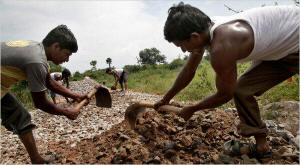
Villagers work at a road construction site under a government program in Andhra Pradesh, India. In decades past, fraud and waste have sapped efforts to help the poor. Rajiv Gandhi, a former prime minister, famously estimated that only 15 percent of every rupee spent on the poor actually reached them. Photo: Kuni Takahashi/New York Times
The Indian state of Andhra Pradesh empowers the poor to fight corruption Lydia Polgreen New York Times December 2, 2010 See the section in Hunger Notes special report Harmful economic systems on Reducing harm

Hands reach to touch the hand of Aung San Suu Kyi after her release from house arrest in Yangon. Photo: AP
Democracy leader Suu Kyi urges 'real genuine talks' in Burma Steve Finch and John Pomfret Washington Post, November 15, 2010 Burmese democracy leader Aung San Suu Kyi freed in Rangoon as crowds celebrate Steve Finch Washington Post November 13, 2010 Burmese election won by military-backed party. Opposition parties concede defeat to USDP but accuse junta of fraud as Barack Obama says election was stolen. Reuters/Gardian.co.uk November 9, 2010 See the section in Hunger Notes special report Harmful economic systems on Keeping people oppressed income
China, India, Brazil have voting rights increased at the International Monetary Fund Bradley S. Kapper Associated Press/Washington Post November 5, 2010 See Hunger Notes special report Trade and hunger
Neighboring countries ponder a post-occupation Afghanistan Karen De Young Washington Post November 4, 2010
In India, greed creeps into microlending, critics say Rama Lakshmi Washington Post October 31, 2010
Nobel peace prize given to jailed Chinese dissident Andrew Jacobs and Jonathan Ansfield New York Times October 8, 2010
Gaining rights for women workers in Cambodia (video) UNIFEM October 9, 2010 Microenterprise for women in India (4 minute video) Trickle Up October 9, 2010
China, Brazil are fueling world economic growth Mimi Whitefield Miami Herald October 7, 2010
US warns China on currency policy William Branigin Washington Post October 6, 2010 See Hunger Notes special report Trade and hunger

North Korea leader Kim Jong Il, right, and his son Kim Jong Un, left, salute from the balcony as they attend a massive military parade marking the 65th anniversary of the communist nation’s ruling Workers’ Party in Pyongyang, North Korea on Sunday. Photo: Kyodo News, via Associated Press
North Koreans boost power of ruler's kin Martin Fackler and Mark McDonald New York Times September 28, 2010 See Hunger Notes special report harmful economic systems
Generals in Pakistan push for shakeup of government Jane Perlez New York Times September 28, 2010 See Hunger Notes special report harmful economic systems

A woman washes clothes along a river in Bangladesh. The Ganges, Brahmaputra and Meghna rivers - together one of the largest freshwater flows in the world - pass through Bangladesh on their way to the ocean, but the rivers flow from the Himalayas through countries including India and China that, as the snow melt from the Himalayas declines, are planning dams to conserve water for their own use. This would drastically reduce the water available to Bangladesh, affecting its agriculture. Photo: Manoocher Deghati/IRIN
India and China's plans to dam rivers before they flow through Bangladesh could destroy nation’s agriculture IRIN News September 20, 2010 Egypt and thirsty neighbors are at odds over Nile Thanassis Cambanis New York Times September 25, 2010 See Hunger Notes special report The environment and hunger

Angelo Nuestro, 16, right, packed to return to Italy with his aunt, Jocelyn Santia, who works in Milan. Photo: Jes Aznar/New York Times
Philippine workers overseas toil far from home, dream of their return to their country, and send home income representing 10 percent of the total Philippine national product Normitsu Onishi New York Times September 18, 2010

Some families have gone days without a decent meal. Photo: Abdul Majeed Goraya/IRIN
Pakistan: What did you eat today? IRIN News September 1, 2010
Upstarts chip away at the power of Pakistani elite Sabrina Tavernise New York Times August 28, 2010 See Hunger Notes special report Harmful economic systems especially the section on reducing harm
Indian government agency fights US companies trying to copyright their versions of yoga. Yoga is ancient collective knowledge and should be available for use by anyone, agency says Emily Wax Washington Post August 23, 2010 See Hunger Notes special report Trade and hunger, especially the section on intellectual property rights

Dr. Archana R. Khade, left, and a nurse, Sunita Laxman Jadhav, right, explained incentives to delay childbirth to a new bride near Satara this month. Photo: Kuni Takahashi/New York Times
India tries using cash payments to slow birthrates Jim Yardley New York Times August 21, 2010 See more health stories

Jogdiya, 2, lay with an intravenous drip in the Jhabua District Government Hospital as his father, Ratan Bhuria, looked after him and his 4-year-old sister. Bhuria’s children hover at the edge of starvation. His daughter, Nani, is 4 and weighs 20 pounds. His son, Jogdiya, is 2 and weighs only eight. Landless and illiterate, drowned by debt, Mr. Bhuria and his ailing children have staggered into the hospital ward after falling through India’s social safety net. They should receive subsidized government food and cooking fuel. They do not. The older children should be enrolled in school and receiving a free daily lunch. They are not. And they are hardly alone: India’s eight poorest states have more people in poverty — an estimated 421 million — than Africa’s 26 poorest nations. Photo: Lynsey Addario/ New York Times
India asks: Should poor people have a right to food? Jim Yardley New York Times August 8, 2010 See excellent accompanying photo slideshow. A Failure to Feed. See Hunger Notes special report: Food is a human right--or is it? For other stories about the hard lives of poor people see World hunger photos: the stories of people's lives

Pakistani rescue teams try to reach tens of thousands of people cut off by floods which are now estimated to have affected three million people. Photo: BBC
Pakistan floods: Rescuers aim to reach stranded victims BBC News August 3, 2010

Men queue for food assistance in the wake of Cyclone Sidr. Along with India, Bangladesh has the highest proportion in the world of newborns with low birth weight. Micronutrient malnutrition is also at alarming levels in Bangladesh, affecting nearly 30 million women and 12 million children under five years old. Photo: David Swanson/IRIN
Bangladesh: Unemployment, food prices, high population growth spur growing hunger IRIN July 22, 2010 See Hunger Notes special report The world financial, food and hunger crisis

A security guard standing at the entrance of a Mercedes Benz dealer in Islamabad. Photo: Kuni Takahashi/New York Times
Controlling the government, Pakistan’s elite pay few taxes, widening the vast gap between rich and poor, hindering development, and creating conditions that have sparked insurgency Sabrina Tavernise New York Times July 18, 2010 See Hunger Notes special report: Harmful economic systems including the sections 'Obtaining income' and 'Impact on development'
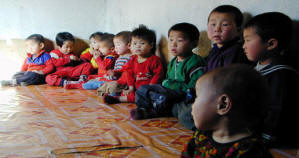
Many North Koreans lack food and basic medical care, a report by Amnesty International said this week Photo:Gerald Bourke/AP
North Korea's giant leap backwards: Last year's disastrous currency reform wiped out savings and caused healthcare to collapse--now many fear another famine Barbara Demick The Guardian July 17, 2010 See Hunger Notes special report: Harmful economic systems including the section 'Impact on development'

An aerial shot of a palm oil plantation on Sumatra Island. Photo: Jefri Aries/IRIN
Indonesia: Demand for palm oil fuels land-grabbing IRIN July 6, 2010 See Hunger Notes special report: Harmful economic systems including the section 'Obtaining income'.

Maj. Gen. Khattiya Sawatdiphol, who had allied himself with protesters, was shot in the head on Thursday in Bangkok. Photo: Steve Pace/Reuters More Photos
Thai general linked to protests is shot Thomas Fuller and Seth Mydans New York Times May 13, 2010
![Ilyas Masih with one of his seven daughters. Feeding so many is not easy. "I struggle even to buy a single kilo of `atta’ [wheat flour], which costs Rs 30 [36 US cents], and even that produces just about half a `roti’ [flat bread] for each of us,” he said. For Ilyas’s family, securing each meal - eaten on the floor around a kerosene oil stove on which Nasim cooks - is an ordeal. “Especially at night, it is painful to hear the children beg for more food. Sometimes they snatch food from each other,” Ilyas said. Photo: Kamila Hyat/IRIN](images/pakistan_7children.jpg)
lyas Masih with one of his seven daughters. Feeding so many is not easy. "I struggle even to buy a single kilo of `atta’ [wheat flour], which costs Rs 30 [36 US cents], and even that produces just about half a `roti’ [flat bread] for each of us,” he said. For Ilyas’s family, securing each meal - eaten on the floor around a kerosene oil stove on which his wife, Nasim, cooks - is an ordeal. “Especially at night, it is painful to hear the children beg for more food. Sometimes they snatch food from each other,” Ilyas said. Photo: Kamila Hyat/IRIN
Pakistan: A family of 9, living on $1.20 a day IRIN News May 7, 2010 See other stories about people living in hunger and poverty.

An estimated six million Indonesian woman - some 90 percent of all Indonesian migrant laborers - are now working overseas. Most go to the Middle East, with the rest are in Asia Pacific. Many Indonesian villages are left with a shortage of women with many men assuming the role of a single parent for years at a time. Photo: David Swanson/IRIN
Families struggle as 6 million Indonesian women work abroad IRIN News May 7, 2010

Once a popular Muslim street in Jaffna, Moor Street sits in disrepair today. Sri Lankan Muslims displaced by the Tamil rebels during the country's decades-long civil war are slowly returning home, but the challenge of reconciling with their Tamil neighbors and the past, remains. Photo: Contributor/IRIN
Sri Lanka: Muslims and Tamils deal with the past IRIN News April 29, 2010

Transferring drinking water from one pail to the next. People must pay the equivalent of up to $1 daily to buy clean water for drinking and cooking from vendors transporting water in jugs.Photo: Jefri Aries/IRIN
People in Jakarta's slums must pay nearly $1 per day for fresh water while living on less than $2 per day, and bath and wash clothes in murky gray water from fish ponds IRIN News April 16, 2010 More nutrition and health stories
Pakistan government failed to do enough to protect former president Benazir Bhutto and failed to properly investigate her murder, UN commission finds Al Jazeera April 16, 2010
Campaign to eradicate polio makes real progress in countries most affected, Nigeria and India Celia W. Dugger New York Times April 6, 2010 More nutrition and health stories

Almost eight out of 10 people without access to both clean water and safe toilets live in rural areas; most are in Southern Asia. Photo: UNICEF Cambodia
The World Bank and other donors must do more to combat growing water shortages and poor sanitation in developing countries World Bank Independent Evaluation Group April 7, 2010 More development assistance stories
In Timor-Leste, government and population cope between harvests IRIN News April 1, 2010
Dams along Mekong River borders not thought by farmers or fishermen to ease drought Thomas Fuller New York Times April 1, 2010 El Niño blamed for unprecedented drought in Vietnam IRIN News March 30, 2010

Tom Albanese, Rio Tinto’s chief executive, after meeting Monday with Prime Minister Wen Jiabao at the Great Hall of the People. Pool Photo: Feng Li/Pool photograph
Rio Tinto executives in China admit taking bribes David Barboza New York Times March 22, 2010 See article on Transparency International's Corruption Perceptions Index See Hunger Notes special report Harmful Economic Systems

Workers loaded sugar for delivery last month at Hacienda Luisita, a Philippine plantation that is owned by the family of former President Corazon C. Aquino. Photo: Jes Aznar/New York Times
One sugar plantation--owned by the family of ex-President Aquino--illustrates the contentious path of land reform in the Philippines Norimitsu Onishi New York Times March 14, 2010 See Hunger Notes special report: Harmful economic systems
Thai court seizes $1.4 billion from ex-premier Seth Mydans and Thomas Fuller New York Times February 26, 2010 See Hunger Notes special report: Harmful economic systems
Amid starvation, runaway inflation, and food shortages in the Army, North Korea fires top economic officials, South Korean press reports Blaine Hardin Washington Post February 5, 2010

Suicide has emerged as the single leading cause of death among women in Nepal aged 15-49. The report listed general causes for suicide such as mental health problems, relationships, marriage and family issues, and youth (since 21 percent of the suicides were committed by young women aged 18 years and under) but did not elaborate on causes. Photo: Brennon Jones/IRIN
Nepal: Why are so many young women killing themselves? IRIN News January 22, 2010

The two men were also convicted of leaking details of a network of tunnels reportedly being built in Burma. It is thought the tunnels were built to house communications systems, possible weapons factories and troops in the event of an invasion. Photo: BBC
Burmese officials sentenced to death for revealing government visits to Russia and North Korea and information about military tunnels BBC News January 7, 2010
North Korean currency crackdown fuels food shortages; government's aim is to decrease reliance on markets, which now provide about half of North Korea's food, but which also represent an alternative source of economic, and thus political, power Blaine Hardin Washington Post January 8, 2010 See Hunger Notes special report: Harmful economic systems
Indonesia: Internet facilitates illegal kidney trade--Thomas sells kidney through internet website to pay for mother's hospitalization IRIN News January 8, 20010
In audit, China finds large ($35 billion) and widespread corruption by government officials David Barboza New York Times December 29, 2009 See Hunger Notes special report: Harmful economic systems
Leading Chinese dissident, Liu Xiaobo, gets 11 year term for subversion after he helped draft a petition known as Charter 08 that demanded the right to free speech, open elections and the rule of law Andrew Jacobs New York Times December 24, 2009 With harsh sentence of Liu Xiaobo, China threatens democracy and human rights activists and signals to the West that its concerns don't matter much Andrew Jacobs New York Times December 25, 2009 See Hunger Notes special report: Harmful economic systems
In Indonesia, middlemen mold outcome of justice by persuading corrupt police officers, prosecutors and judges to drop a case against a client for the right amount of money Norimitsu Onishi New York Times December 19, 2009 See Hunger Notes special report: Harmful economic systems
Pastoralism unraveling in Mongolia due to low wool prices and high number of goats, creating environmental damage Sarah J. Wachter New York Times December 8, 2009

Street children sleep on the path of one of Dhaka’s roads, Bangladesh. Photo: Manoocher Deghati/IRIN
Bangladesh: over half of all children living in poverty IRIN News December 3, 2009