 |
 |
|
|
| DEPARTMENTS | |||

|
|||

|
|||

|
|||

|
|||

|
|||

|
|||

|
|||
| YOU CAN!... | |||
|
|||

|
|||
|
|||
|
|||
| MORE ABOUT HUNGER NOTES |
|||
 |
|||

|
|||

|
|||
|
|||
|
|||
|


Harmful economic systems: Keeping people oppressed
In essence, there is part of the population that is living well because of their control of assets and people. The people whose assets and income have been reallocated don’t like this and thus there is the threat of revolution—overturning the minority in benefit of the majority. This is prevented in a number of ways.
1. Murder, torture, arrest, imprisonment, surveillance, bombing
In rural Egypt, democracy withers Abigail Hauslohner Washington Post May 3, 2014
529 Egyptians sentenced to death over the killing of a police officer David D Kirkpatrick New York Times March 24, 2014 Egyptian authorities detain thousands amid crackdown on dissent Erin Cunningham Washington Post March 10, 2014
While the United States is not blatently using its surveillance techniques to oppress its people, it is certainly a leader in surveillance, which can be used to oppress (and under a reasonable understanding of the degree to which a government is entitled to monitor its citizens, it is oppressing its citizens). We thus include articles revealing US surveillance practices. License plate cameras track millions of Americans Craig Timberg Washington Post July 17, 2013 US postal service logging all mail for law enforcement Ron Nixon New York Times July 3, 2013 Bolivia complains to UN after Evo Morales' plane 'kidnapped.' US refuses to comment on Morales plane but admits contact with other nations over potential Snowden flights. Sara Shahriari, Jonathan Watts, and Dan Roberts The Guardian July 3, 2013 Barring of Bolivan plane infuriates Latin America as Snowden case widens William Neuman and Alison Smale New York Times July 3, 2013 National Security Agency collecting phone records of millions of Verizon customers daily The Guardian June 5, 2013
In hard times, open dissent and repression rise in Vietnam Thomas Fuller New York Times April 23, 2013
Filmmakers capture chaos after airstrikes in Syria Robert Mackey New York Times April 11, 2013
Arrests, intimidation and no new Zimbabwe Nyarai Mudimu Inter Press Service March 21, 2013
Researchers find 25 countries using surveillance software Nicole Perlroth New York Times March 13, 2013
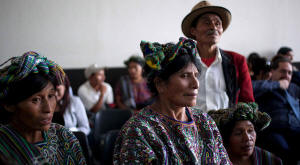
Relatives of victims of Guatemala's civil war listened to proceedings as Efraín Ríos Montt, Guatemala’s former military dictator, was ordered by a Guatemalan judge on Thursday to stand trial on charges of genocide and crimes against humanity leveled at him. Rodrigo Abd/Associated Press
Accused of atrocities, Guatemala’s ex-dictator chooses silence Elisabeth Malkin New York Times January 26, 2013
Eight former army officers are charged with Chilean singer's 1973 murder after army coup Pascale Bonnefoy New York Times December 28, 2012 See Wikipedia Victor Jara Hear Jara's song Manifiesto
Opposition to labor camps widens in China Andrew Jacobs New York Times December 14, 2012
2. Inhibiting political, human rights and other organizations
Eritrea and North Korea are the world's most censored countries, advocacy group says Rick Gladstone New York Times April 21, 2015
Ecuador legislature approves curbs on news media William Neuman and Maggy Ayala New York Times May 14, 2013
China cracks down on anti-corruption activists Andrew Jacobs New York Times April 21, 2013
Journalism under attack across the globe imperils press freedom Roy Greenslade The Guardian February 14, 2014 Attacks on the Press: Journalism on the Front Lines 2012 Committee to Protect Journalists
Many governments target rights defenders in order to suppress human rights, Human Rights Watch says in a 90 country report Hunger Notes February 5, 2010
Some excerpts from the above article, with links to brief country reports. Attacks on human rights monitors are not limited to authoritarian governments like Burma and China, Human Rights Watch said. Human Rights Watch noted that some governments are so abusive against individuals and organizations that no domestic human rights movement can function, citing Eritrea, North Korea, and Turkmenistan. The introduction to the report said that in addition to Russia and Sri Lanka, other countries where human rights monitors were murdered in order to silence them in included Kenya, Burundi, and Afghanistan. Human Rights Watch cited Sudan and China as countries that routinely shut down human rights groups and Iran and Uzbekistan as countries that openly harass and arbitrarily detain human rights workers and other critics. Colombia, Venezuela, and Nicaragua threaten and harass rights defenders. Human rights advocates face violence in countries such as The Democratic Republic of Congo and Sri Lanka. Some governments such as Ethiopia and Egypt use extremely restrictive regulations to stifle the work of nongovernmental organizations. Other countries use the disbarment of lawyers (China and Iran, for example), criminal charges - often faked from staged attacks (Uzbekistan and Turkmenistan), and criminal libel laws (Russia and Azerbaijan) to silence critics.
3. Electoral fraud and manipulation, government overthrow
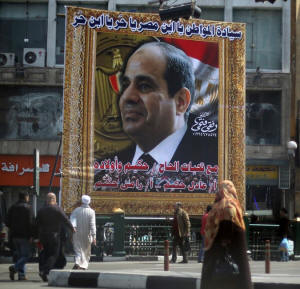
A banner for the soon-to-be-elected president, Abdel Fattah el-Sisi, displayed in Cairo in March. The election is pro-forma, as Sisi and allies overthrew the democratically elected govenment of President Morsi. Photo: Amr Abdallah Dalsh/Reuters
Egypt's new strongman, Sisi knows best David D Kirkpatrick New York Times May 24, 2014
Thai military declares a coup, detains key political leaders Chico Harlan and Lennox Samuels Washington Post May 22, 2014 Also see
Class war: Thailand’s military coup. Outnumbered by the country's rural voters, Thailand's once vibrantly democratic urban middle class has embraced an elitist, antidemocratic agenda. Walden Bello Foreign Policy In Focus May 27, 2014
There has been a long history in the United States of denying African Americans the right to vote. Slaves could not vote; and after the slaves were freed, Southern states imposed laws making it difficult or impossible for African Americans to vote. We thus include these recent developments. In Senate, an emotional appeal to restore 'heart and soul' of Voting Rights Act is made by Rep. John Lewis of Georgia, a leader of the 1965 march from Selma to Montgomery Warren Richey Christian Science Monitor July 17, 2013 After Supreme Court ruling, southern States rush to establish new laws requiring voters to show photo identification at the polls, which would make it harder for many poor people and members of minorities to vote Michael Cooper New York Times July 5, 2013 Supreme Court stops use of key part of Voting Rights Act Robert Barnes Washington Post June 25, 2013 Take the impossible “literacy” test Louisiana gave black voters in the 1960s Rebecca Onion Slate June 28, 2013