 |
 |
|
|
| DEPARTMENTS | |||

|
|||

|
|||

|
|||

|
|||

|
|||

|
|||

|
|||
| YOU CAN!... | |||
|
|||

|
|||
|
|||
|
|||
| MORE ABOUT HUNGER NOTES |
|||
 |
|||

|
|||

|
|||
|
|||
|
|||
|


2010 Global
World hunger facts Global web links
For climate change and other environmental issues see the Hunger Notes special report Global issues: the earth, the environment, and poor people
Freedom House releases report showing decline in democracy worldwide Hunger Notes January 13, 2011
No police in Mexico town after last officer kidnapped BBC News December 28, 2010

In the 20 years since the Rev. David Beaumont came to serve the Pima Indians of Yecora, the region has become one of most dangerous drug-growing areas in the world. Photo: Washington Post
American missionary brings solace to drug-torn Mexican region Nick Miroff Washington Post December 6, 2010
International Monetary Fund criticized for very conservative governance reform: China, Brazil, India and Russia receive some increased voting power, while most developing counties had their voting power reduced, and European countries keep their disproportionate voting power Matthew O. Berger IPS December 8, 2010 See Hunger Notes special report: Trade and hunger
Haiti's long, painful wait to rebuild William Booth and Mary Beth Sheridan Washington Post November 24, 2010
UNAIDS reports progress against HIV: New infections have fallen and more people have access to treatment, although two-thirds of those infected still lack access to treatment Thomas H. Maugh II Los Angeles Times November 23, 2010 See full report More nutrition and health stories
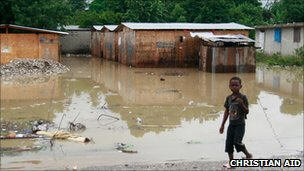
Health officials and aid organizations fear that the flooding will lead to a very large rise in cholera infections. Photo: Christian Aid/BBC News
Haiti cholera death toll reaches 588 BBC News November 8, 2010
China, India, Brazil have voting rights increased at the International Monetary Fund Bradley S. Kapper Associated Press/Washington Post November 5, 2010 See Hunger Notes special report Trade and hunger
Brazil elects a woman president: Brazilians vote strongly in favor of continuing the economic and social policies of current president Lula da Silva Alexei Barrionuevo New York Times October 31, 2010
Global extinction crisis looms, with one-fifth of all animals now facing extinction, report says Juliet Eilperin Washington Post October 27, 2010 UN report stresses the value of nature to world's economies, especially to the world's poor people Juliet Eilperin Washington Post October 20, 2010 See Hunger Notes special report The environment and hunger
Special report: is aid doing Haiti more harm than good? Simon Denver Reuters October 25, 2010 See Hunger Notes special report Development and humanitarian assistance

Barely two generations ago, the gently rolling hills here in Brazil's heartland were a knot of short, brittle trees and acidic soil considered unfit for agriculture. But on a recent morning, a New Holland harvester cut through golden husks of wheat on Paulo Kramer's farm. Wheat, of course, is a temperate crop that flourishes in places like Kansas and South Dakota. But here in Brazil's Cerrado, a wide savannah that covers nearly a quarter of the country, wheat varieties created especially for tropical climates and nutrient-poor soil bloom alongside corn, soybeans and cotton. Photo: Juan Forero/Washington Post
Brazilian crop scientists turning nation into agricultural power Juan Forero Washington Post October 17, 2010
Water, the new oil: The race to buy up our most precious natural resource Newsweek October 8, 2010 See Hunger Notes special report The environment and hunger
China, Brazil are fueling world economic growth Mimi Whitefield Miami Herald October 7, 2010
Global fight against AIDS falters as pledges fail to reach goal of $13 billion Donald G. McNeil Jr. New York Times October 5, 2010 See more nutrition and health stories
Protracted conflicts boosting world refugee totals, UN says Reuters New York Times October 4, 2010 See Hunger Notes special report Development and humanitarian assistance
Chavez fails to reach critical two-thirds majority in Venezuelan assembly Juan Forero Washington Post September 28, 2010 How Chavez lost the popular vote and won by a landslide Washington Post October 1, 2010

The area is home to 6,500 families who are collectively known as the Zabaleen, Cairo's garbage collectors. In the shadow of the Coptic Christian church cut into the sandy rock face, lies Moqattam – or "Garbage City" as it's known – which houses an entire community dedicated to recycling 4,500 tons of rubbish every day from Cairo. Straight from the streets of Egypt's biggest city, the rubbish is collected and delivered in trucks every day before it is apportioned to the area's families for separation. Some families have specialties such as leather, electrics, tin cans or plastic bags. From food to furniture everything is recycled. The whole family participates--fathers, mothers, children, grandparents, all join in to harness someone else's waste into a resource which can keep them clothed and fed.
The recycling capital of the world? A poor slum in Cairo where garbage comes to be sorted, and nothing is wasted Donal MacIntyre The Independent October 5, 2010

Every day Ster Mamboza, 37, covers 19 km on a bicycle over sand and gravel roads to the well at Machaze, in the southern Mozambican province of Manica, carrying two 20-litre plastic water containers and a two-month-old baby. It’s quite a balancing act. The better part of her day--up to six hours-- is spent fetching water from this well, the nearest safe source in the area. government figures show that in rural Mozambique only 30 percent have access to safe water. Mozambique (along with many other countries) has made scant progress in achieving the Millennium development goal for water. Photo: Andre Carueira/IRIN
UN foresees dramatic cuts in world poverty Mary Beth Sheridan Washington Post September 21, 2010 UN Millennium Development Goals appear out of reach in Africa Robyn Dixon Los Angeles Times September 20, 2010
World hunger dips, but not by much IRIN News September 14, 2010 See more nutrition and health stories

Four million children dying of 'neglect' BBC News September 7, 2010 See more nutrition and health stories
US pressures for less Europeans and more developing countries on International Monetary Fund board Howard Schneider Washington Post September 22, 2010 US pressures IMF to expand role of growing economies Sewell Chan and David Jolly New York Times September 9, 2009 See Hunger Notes special report: trade and hunger, especially the section on realigning representation on international organizations
What are the links between shame and poverty? Chris Arnot The Guardian August 24, 2010
Aid groups using cellphones to reach the world's poor Cecilia Kang Washington Post September 7, 2010
Who pays for US and European agricultural subsidies? Farmers in developing countries Timothy A. Wise Tufts University August 19, 2010 See Hunger Notes special report: Trade and hunger

Russians fought a fire near the village of Golovanovo, in the Ryazan region of Russia on Thursday. Dry conditions have led both to failure of the wheat crop and widespread forest fires over a large region. Photo: Natalia Kolesnikova/Agence France-Presse — Getty Images
Russia bans grain exports after millions of acres of wheat wither in severe drought Andrew E. Kramer New York Times August 5, 2010 Wheat prices reach 22 month high--up 50 percent since June due to severe drought in Russia BBC News August 3 2010 See Hunger Notes special report The world financial, food and hunger crisis

Proposals to develop and commercialize ‘genetic-use restriction technologies’ (GURTs also called terminator seeds) are back on the agenda for policymakers and the biotechnology industry. Genetically Modified crops using the terminator technology produce sterile seeds to prevent farmers from replanting harvested seed with patented DNA. Due to international public outcry from farmers and civil society worldwide, Terminator has never been commercialized anywhere. But various developments, including acquisition of the patent rights to terminator technology by Monsanto, the largest seed company in the world, have increased pressure to adopt the technology. Photo: Greenpeace
La Via Campesina issues call to action to stop development and commercialization of 'terminator' seeds La Via Campesina July 28, 2010
World Bank warns on farmland grab: Foreign investors target countries with weak laws, buying arable land on the cheap and failing to deliver on promises of jobs and investments Javier Blas Financial Times July 27, 2010 See Hunger Notes special report Harmful economic systems especially the section on international aspects
In Haiti, one-third of population without adequate access to food since earthquake: Spring, 2010 update FAO Global Information and Early Warning System (GIEWS)

Workers secure ropes around a mine shaft in Taxco, Mexico, where dozens of bodies were found in a mass grave, victims of drug wars. Photo: Margarito Perez/Reuters
Mass grave in Taxco, Mexico, (a popular tourist destination) is largest discovered in violent drug wars William Booth June 24, 2010 See Hunger Notes special report: Harmful economic systems including the sections 'Obtaining income' and 'Impact on development'

Fishermen repair their nets in the Mexican coastal town of Ciudad del Carmen. Thirty-one years after the Ixtoc oil rig explosion and spill, there's not much fishing work. Photo: Chris Granger/Times-Picayune
Ixtoc oil well blowout in Gulf of Mexico: 1979 disaster parallels and lessons Ramon Antonio Vargas New Orleans Times-Picayune, July 4, 2010
Water need is high in Fertile Crescent: Government regulations not heeded IRIN News June 23, 2010
Global: G8 falls short on development aid IRIN News June 22, 2010 See Hunger Notes special report on development (and other) aid
At least 6.8 million people were displaced last year, mainly by long-running conflicts, pushing the number of those forced to live away from home to 27 million - the highest since the mid-1990s IRIN News May 28, 2010 Access full report
Child deaths decrease from 11.9 million in 1990 to an estimated 7.7 million this year--still a great distance from Millennium development goal of reducing child deaths by two-thirds (to about 4 million) in 2015 Denise Grady New York Times May 23, 2010

Most women in sub-Saharan Africa give birth with no skilled health worker present. Photo: Anne-Isabelle Leclercq/IRIN
Global: The worst places to be a mother IRIN News May 7, 2010 More nutrition and health stories More development assistance stories
Development aid increases, but by much less than promised. In 2005 donors collectively promised to commit 0.56 percent of gross national income to aid by 2010, but reached just 0.31 percent in 2009. IRIN News April 27, 2010 More development assistance stories
Great Britain passes law controlling 'vulture funds' IRIN News April 13, 2010 What are vulture funds? See US campaign against vulture funds See more debt and development stories
Does international health aid reduce developing country government health spending? Yes IRIN News April 12, 2010 More nutrition and health stories
Maternal death rates drop around the world--down 40% since 1980. Six countries account for half of all maternal deaths David Brown Washington Post April 14, 2010 More nutrition and health stories

Salvadorans rally in honor of Archbishop Oscar Romero in the capital on the 30th anniversary of his death. President Mauricio Funes, the nation's first leftist leader, asked forgiveness on behalf of the state for the assassination, blamed on a right-wing death squad. Photo: Jose Cabezas/AFP/Getty Images
El Salvador publicly marks Archbishop Romero's killing for first time Alex Renderos Los Angeles Times March 24, 2010 Order to kill Romero came from right-wing party leader Robert D'Aubuisson, assassination participant says Anne-Marie O'Connor Washington Post April 6, 2010
US and Brazil reach last-minute, temporary agreement on cotton dispute (the WTO found the US unfairly subsidizing its cotton growers; Brazil was set to impose WTO-approved sanctions violating US intellectual property rights) Sewell Chan New York Times April 6, 2010 See Hunger Notes special report: Trade and hunger
European Union countries will give all food aid by buying food in or near the country in need of emergency food assistance, not by purchasing food in European countries IRIN News April 2, 2010 New York Times April 6, 2010 More development assistance stories
The World Bank and other donors must do more to combat growing water shortages and poor sanitation in developing countries World Bank Independent Evaluation Group April 7, 2010 Unsafe water kills 1.8 million children worldwide IRIN News March 22, 2010 Eight out of 10 people without toilets in 10 countries IRIN News March 22, 2010
Drug gangs kill three in two attacks on US officials and their families in Ciudad Juarez Marc Lacey and Ginger Thompson New York Times March 14, 2010 Fearing drug cartels, reporters in Mexico retreat Marc Lacey New York Times March 13, 2010 El Paso and Ciudad Juárez, border towns on each side of the Rio Grande, are worlds apart in violence caused by drug importation to the United States Dan Barry New York Times February 13, 2010 See the New York Times series 'War without borders' on drug trafficking between Mexico and the United States. Also see Hunger Notes special report: Harmful economic systems

This graph shows (an index of) the price of food throughout various years, with the average price for 2002-2004 taken as 100. The graph shows that from February to August 2008, food prices were 200 percent or more of the the base years of 2002-2004. In 2010, the graph shows that food prices are still 70 percent greater than the average of 2002-2004. For most hungry people (other than those in zones of conflict or natural disaster) the price of food is critical, as people are hungry because they are poor and can barely afford food. When prices are high, food is available, just not affordable to very poor people, and they go hungry. An estimated 16 million people go hungry for every one percent increase in the price of staple foods.
Are we heading for another food crisis? IRIN News March 2, 2010 See Hunger Notes special report: The world financial, food and hunger crisis
Brazilian Congress approves incorporation of the right to food into the Brazilian constitution FIAN International February 9, 2010 Also see Hunger Notes special report: Food is a human right--or is it?
Many governments target rights defenders in order to suppress human rights, Human Rights Watch says in a 90 country report Hunger Notes February 5, 2010 See Hunger Notes special report: Harmful economic systems

Haitian children prepared to eat dinner recently at the Foyer of Patience orphanage in Port-au-Prince. Many such centers are barely habitable. Chronic problems — like inadequate services, overwhelming poverty and shady orphanages — have only intensified, while the authorities fear that some of the less scrupulous orphanages are taking advantage of the chaos to round up children in crisis and offer them for sale as servants and sex slaves. It took the arrest last weekend of 10 Americans caught trying to leave the country with 33 Haitian children to focus international attention on the issue. While there is no evidence that the Americans, who said they were trying to rescue children in the aftermath of the earthquake, intended any harm, the ease with which they drove into the capital and scooped up a busload of children without documents exposed vast gaps in the system’s safeguards. Lynsey Addario/New York Times Photos of Haiti orphanages See also World Hunger pictures and stories
Bleak portrait of Haiti orphanages raises fears for the children Ginger Thompson New York Times February 6, 2010

Only one man is left to help tuberculosis patients amid the rubble of Haiti's only TB sanatorium Ian Urbina New York Times February 5, 2010 (Factsheet: Haiti has the highest rate of TB in the Western Hemisphere)

More than 150,000 have been buried, Haiti says Damien Cave New York Times January 23, 2010 Operation under way to evacuate 400,000 from Haiti’s broken capital TimesOnline.co.uk January 22, 2010 Haiti homeless reach 2 million Rory Carroll, Esther Addley and James Meikle Guardian.co.uk January 21, 2010 After the cameras leave, what will be the US role in Haiti? Domination or neglect have been the two historical responses. Helene Cooper and Mark Landler New York Times January 18, 2010 Haiti earthquake: thousands feared dead BBC News January 13, 2010
Businessman wins Chile’s presidency Alexi Barrionuevo New York Times January 18, 2010

Plumpy'nut is one of the most widely distributed ready-to-use therapeutic foods (RUTF), given to children suffering from malnutrition. The patents for Plumpy'nut - a blend of peanuts, sugar, milk powder, oil, vitamins and minerals - are owned by a French company and a research institute. Manufacturers of similar pastes have been reluctant to challenge Nutriset because the patents are so broad, but two US companies just have, saying there should be "no restrictions on the development and production of life-saving food aid". Photo: Georgina Cranston/UNICEF
Plumpy'nut patent under pressure IRIN News January 12, 2010 See also Birthplace of an innovation saving the lives of starving children--a blender in Malawi IRIN News June 22, 2007 See Hunger Notes special report: Trade and hunger
Brazilians reflect on President Lula's last year Gary Duffy BBC News January 11, 2010
Report on lawyer's death eases a political crisis in Guatemala Elisabeth Malkin New York Times January 13, 2010 See earlier story: Video made by Guatemalan lawyer blames his slaying on Guatemalan president William Booth Washington Post May 14, 2009
Venezuela to devalue its currency BBC News January 8, 2010 After currency devaluation, Chavez warns businesses that he will nationalize those that raise prices Reuters New York Times January 10, 2010 See Hunger Notes special report: Harmful economic systems

Raimundo Teixeira de Souza held the residents’ card of his stepson who was killed, probably in a land dispute. Teixeira de Souza was forced to sell his land for a pittance to more powerful farmers, who roam this Wild West territory with rifles strapped to their backs. Photo: André Vieira/New York Times
Land grabs widespread in lawless Amazon region of Brazil--government now trying to impose greater order Alexi Barrionuevo New York Times December 26, 2009
Esther Chavez, 68: Activist who denounced the brutal slayings of over 100 poor women in the border city of Ciudad Juarez and demanded that the deaths be properly investigated Olivia Torres Associated Press December 26, 2009