 |
 |
|
|
| DEPARTMENTS | |||

|
|||

|
|||

|
|||

|
|||

|
|||

|
|||

|
|||
| YOU CAN!... | |||
|
|||

|
|||
|
|||
|
|||
| MORE ABOUT HUNGER NOTES |
|||
 |
|||

|
|||

|
|||
|
|||
|
|||
|


Development Education in U.S. Formal Education
Is development education taking place in the United States formal education sector: K-12 (Kindergarten to 12th Grade) and higher education?
I posed this question to some teachers and professors working in this country's schools and universities. Their almost unanimous response: "no."
With a little more discussion, however, they may actually be responding "yes."
Let us explore what this means and how this comes about, taking into consideration four key issues: terminology, standards, teaching, and teachers.
|
|

Terminology
One obstacle to the understanding of, and, hence, implementation of development education is terminology. "We talk about internationalizing the curriculum at the college level," states Dr. Angene Wilson of the University of Kentucky, "but we do not typically use the term global education or development education."
The same is true for K-12 education, What one person calls "development education" may be what someone else terms "global education" or "international education."
|
Corcoran High School student Ronni Copeland and Roberts teacher are leading Roberts 3rd graders in an Ashanti children's game. The Corcoran/Roberts Peace Corps Partnership Project funded the construction of a kindergarten for the villagers of Mensase, Ghana. Corcoran students taught lessons about the Ashanti culture-- language, foods, dance, customs-- to the Roberts classes. |

Or it may be that some do not have a definition for it at all. In fact, beyond the education and development communities (e.g., the readers of this publication), the term elicits confused looks. "Doesn't that have to do with fundraising?" is a typical response.
While the lack of a consistent terminology may cause some confusion, there are more important issues in establishing development education— however referred to— in the curriculum. These refer to characteristics and requirements of the formal education sector in the U.S. today and how formal education relates to and/or supports development education.
Standards
In the K-12 classroom, the driving force behind curriculum content is "standards." Every subject has them. Every teacher must know them and must teach them. National and state standards prescribe what teachers should teach and students should be able to do at each stage in their academic career. Every teacher I have spoken to recently has indicated that unless what we are asking them to do fits the standards, they cannot do it. So, is development education in the standards? No, not exactly. Does it fit the standards? Most certainly.
Teaching
Consider one example.
As a mathematics teacher, I knew from the National Council of Teachers of Mathematics standards that my students must be able to understand and use functions. I often felt constrained by typical textbook examples asking students simply to plug numbers into given equations or to write mathematical models for seemingly trivial situations. I shared my students' frustration at not being able to grasp textbook examples showing that y (some unidentified variable) is a function of x (another unidentified variable). Typical examples from a textbook from which I had to teach asked students to consider how long it takes you to wake up-- an abstract concept-- depending on the temperature outside. Students are frequently given data (and often simply whole numbers) that fit neatly into an equation.
|
A High School, an Elementary School, and a Partnership with a Peace Corps Volunteer Overseas Since 1983 the students at Corcoran High School in Syracuse, NY, have been raising awareness, as well as needed funds, for projects coordinated annually by Peace Corps Volunteers in their countries of service through the Corcoran-Roberts Peace Corps Partnership (www.dreamscape.com/phatpc/peace). Each year students in the International Relations Club choose one of many projects in communities requesting funding through the Peace Corps overseas. Over the years they have raised over $85,000 and funded 15 partnerships in Asia, Africa and Latin America, including five primary schools, a school for the blind (the first in all of central Africa), a water well, a medicinal herb garden and (this past school year) an adult literacy project. From their newsletter:
The program incorporates the target project into the Global Studies curriculum, as well as other classes through the drawing of note cards (then sold to raise funds) and cross-cultural exchanges with villagers supported by the project through letters, photos and artifacts. The high school students study the culture of the villages they support, then share their knowledge with the students at Roberts. Both Roberts and Corcoran students engage in special projects to raise the needed funds. The students don't keep quiet about their efforts: their project has been promoted on the Today Show, in the Peace Corps Times, at the biannual International Development Conference, and at regional and national education conferences. |
Why not teach the same lesson using "real world" data now available at the click of a mouse on the Internet or in numerous readily available booklets? For example, is there a relationship between education levels and health for girls and their families in the developing world? (Notice the open-ended exploration instead of "plug and chug" into equations already provided by the textbook). Students learn not only how to interpolate or extrapolate from an equation, but also how to pose a question, find data to fit their needs, determine their own mathematical model and then use it to make predictions on real world situations. (The necessary statistical calculations can be done by hand-held calculators).
Thus, approaching the study of mathematics in such a manner not only teaches the skills prescribed in the standards (national or local) but also provides an exploration and better understanding of the "developing" world (i.e., development education).
In K-12 education, development education is commonly viewed as "belonging" in the social studies. However, significant development education can take place in other disciplines. In fact, it is a natural for an interdisciplinary approach to teaching. My mathematics example above could easily draw in the social studies and sciences, as well as the foreign languages depending on the countries of focus. Gabriell Paye teaches her high school biology classes in Boston about Ethnobotany, incorporating cultural exploration through research and interviews (the social sciences) and experimental design and implementation (science). The possibilities are limitless.
|
Youngsters from Guimini, Mali showing off a book of stories written and illustrated by kindergarten students at John T. Roberts School in Syracuse, New York. The Corcoran/Roberts Peace Corps Partnership Project raised $10,000 for the construction of a primary school which serves 9 Dogon villages at the foot of the Bandiagara cliffs in Mali. Students at Roberts are taught about the culture of the Peace Corps Partnership village by the Corcoran High School students. |

The same possibilities exist at the university level. "I think our problem in higher education is that we are bound by disciplines," continues Dr. Angene Wilson, "so perhaps, for example, a political science instructor teaching World Politics will focus on world hunger and poverty as an issue or perhaps not." Perhaps s/he will focus on other important issues, such as race. Dr. Merry Merryfield of The Ohio State University concurs. "Development education is taught at the college level in Rural Sociology along with women in development and courses in agriculture related to agriculture in developing countries." Wilson is optimistic that discussion has taken place about "the need to cross disciplines, to look at issues more holistically."
Teachers
What do the above obstacles mean for the implementation of development education? Development education can happen. BUT it takes an extra effort on the part of the teacher to make it happen.
|
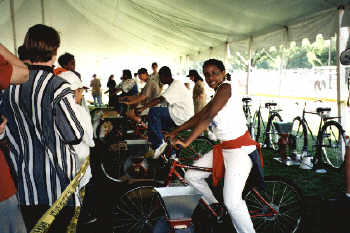
To launch Operation Day's Work-USA (ODW), students and teachers from each Pilot school traveled to Washington, D.C. for an official kick-off event that included a tour of the Adventist Development and Relief Agency (ADRA) Global Village. The purpose of the tour was to expose students to lifestyles in various developing countries and to choose a country that they would like to support through work. At the Global Village, the students participated in activities such as pumping water and here using bicycles to grind corn. |
This need for extra effort, however, does not stop many. Development education is happening in elementary, middle and high schools, as well as in universities, as the examples in the sidebars indicate. Teachers and students with the motivation to do development education can find the resources and support they need. Many teachers have experience in the developing world already. Additional resources and support are available from NGOs and from the federal government. The resource list gives a few key examples of support available.
The sidebars provide a few examples of what educators in the U.S. are doing. While the numbers of activities are not overwhelming, the potential is there.
|
Students and the Federal Government Work Together to Benefit Haitian Children In an effort aimed at exploring the roles of youth in their communities both domestic and international, the U.S. Agency for International Development (USAID) and a number of public and private partners are replicating a highly successful Norwegian development education program, Operation Day's Work. ODW-US (www.info.usaid.gov/about/odw) is a community service learning program. This past year (the pilot year for the project), middle and high school students in Minneapolis, MN; Thetford, VT; Washington, DC; Milwaukee, WI; Grand Forks, ND; and Quincy, MA worked with USAID, local officials, NGOs and the private sector to design, promote and implement the US version of Operation Day's Work. This is how it works: At the start of the school year students solicit and select proposals from NGOs working with communities in economically developing countries. (The students chose to work in Haiti in the pilot year). Schools involved then study Haiti through the school year, but focus their learning for one week in the spring. The culmination of that week is a community service project designed by the students to raise money for their chosen project in Haiti. Although this program is currently coordinated from the top down, it will ultimately mirror the Norwegian model, which is entirely student-run throughout Norway. (See related article in this issue.) |
In two of the three K-12 cases, the projects were carried out because of the interest and experience of the teacher. Teachers are not comfortable having to cover topics of which they know little or nothing. Most of the work described in these examples was initiated and implemented by those who had done their homework. Certainly those who had served in the Peace Corps or who worked for such organizations as USAID have first-hand experience in the developing world. Or, if they did not have direct experience themselves, they have the passion and drive to put the extra time and effort in on their own. There is very little preparation of new teachers or professional development of experienced teachers that provides training in development education. It takes a special person to make that commitment on their own to learn and to share their own learning with their students.
|
High School Students Experience Hunger Globally while Combating Hunger Locally A growing number of schools, colleges and universities are experiencing first hand (however short term) the realities of the availability and distribution of food throughout the world through a Hunger Banquet. One such school is St. George's School in Newport, RI, where students and faculty have been involved in this and other projects promoted by Oxfam America for 10 years. Through educational programs leading up to the Hunger Banquet, students learn that there is adequate food to feed the world, yet the resources are not distributed adequately. At the Banquet itself, a simple drawing of a ticket at the entrance to the dining hall determines if that student (or faculty member) will eat a three-course meal served by candlelight by waiters (15 percent), rice and sauce at a plain table (25 percent) or simply rice from their crowded seat (if they can find space) on the floor (60 percent). This model of real-world inequities in food distribution often leads to mixed emotions by the participants, ranging from guilt to indifference (and enjoyment of much rich food) by the "First World" group and placid acceptance to begging from their "Third World" neighbors. The students at St. George's arranged this event not only to raise awareness of the causes of and potential solutions to world hunger and poverty, but also to raise funds for their other programming. The students of the sponsoring club, Cultural Outreach, chose to put those funds right back into their local community. They used the money raised through this event for a soup kitchen in downtown Newport. Once a month, the students and a faculty advisor set up, prepare, serve and clean up a meal for approximately 100 men, women and children. |
In the case of Operation Day's Work, USA, much of the initial work was done by the United States Agency for International Development (USAID) and its partners directly, from the planning and the publicity to the curriculum. The curriculum implemented in the classroom was provided in part "ready to go." The burden was off the teacher to prepare the material. This approach has two additional advantages: the issues presented are uniformly handled at each different site and the appropriate issues are presented in an appropriate manner.
The Future
|
Kindergarten to 12th Grade (K-12) Development Education Resources This list touches on just a few of the resources available to assist teachers in their development education efforts. Please note that these web sites all have links to many other important development education sites. The reader is encouraged to spend time investigating these links as well. Global TeachNet (www.rpcv.org/globaled)
National Peace Corps Association (www.rpcv.org)
Development Education Program of the World Bank (www.worldbank.org/depweb)
The American Forum for Global Education (www.globaled.org)
United States Peace Corps (www.peacecorps.gov)
|
Three years ago I responded to the question: Does development education have a future? with a definite “yes.”
“It has the potential for a wide-reaching future if we all rise to the challenge to bring it the attention it requires. Begin with the youth of America. Educate the teachers of this country so that they in turn can educate our future generations. As our world grows increasingly interdependent, we need to bring development education further into the classroom, not as a separate curriculum, but as a part of existing programs. Show the students the relevancy and critical importance of their understanding of and participation in the world outside their door. They are ready to rise to the challenge if we are ready to present it to them."
That statement is just as relevant today. I am somewhat discouraged that we have not made more progress. However, we must be optimistic. While the barriers are great, they are not insurmountable. With just a little extra effort and support, teachers can find the resources and motivation they need.
Baker is the Global TeachNet Program Director at the National Peace Corps Association. Global TeachNet is a national network of educators “bringing the world home” to U.S. classrooms. Through the network and the associated grants program, K-12 classroom teachers and other interested educators link for the purposes of disseminating and adapting proven global education curricula. Baker brings to her position experience in classroom teaching, cross-cultural awareness and counseling, and curriculum development. She has a B.A. in Physics from Amherst College and an Ed.M. from the Harvard Graduate School of Education, where she concentrated in international education. She has 10 years of teaching experience at the high school level: two years as a Peace Corps Volunteer teacher of physics, mathematics and physical science in the Fiji Islands and eight years as a mathematics teacher at St. George’s School in Newport, RI. At St. George’s, she founded, developed and administered a student-led organization for global education and community outreach.
copyright