 |
 |
|
|
| DEPARTMENTS | |||

|
|||

|
|||

|
|||

|
|||

|
|||

|
|||

|
|||
| YOU CAN!... | |||
|
|||

|
|||
|
|||
|
|||
| MORE ABOUT HUNGER NOTES |
|||
 |
|||

|
|||

|
|||
|
|||
|
|||
|


Harmful economic systems 2010: Obtaining income
The basic idea and activity in productive societies is helping to produce goods— things that are useful to someone— food, light bulbs, cars— and then exchanging the income received for goods that are desirable to you. This fundamental economic mechanism exists in “harmful” economic societies as well. Unfortunately, also existing, and why we describe these societies as harmful, a certain strata— usually the top— also exists to obtain goods through means which may be described as unproductive or extractive.
The principal ways in which income is obtained in a harmful economic system are twofold: 1) obtain it through the government, or 2) use the government to maintain, consolidate and increase sources of income that are (apparently) obtained in other ways. The first is most typical or at least most evident in developing countries.
Armed conflict--typically the fight by groups for control of the government or territory (frequently possessing natural resources), deserves a separate discussion, because it has been throughout history the principal way in which harmful economic societies have been established and because of its importance in the world today.
Obtaining income through the government There are a wide variety of means in which government officials and others obtain revenue from the government. The first thing to recognize is that people at the top of government, or those who have significant control over the government but who are not government officials--often entrepreneurs or corporations) can and do plunder resources coming into the government. Government revenue is often not devoted to productive services but siphoned off by those in control of the government. A nation expects that its national resources will be used for the benefit of the nation. However very large amounts of such revenue are often used to enrich those in charge of the government. People at lower levels of government can plunder resources too, by not providing services which they are paid to provide, by charging for services which they should provide, or by taking goods, such as medical supplies or automobiles/trucks, which should be used for government service.
Corruption. One name for a particular type of the unproductive allocation of resources is corruption.
Telecom scandal erupts in India: corruption and 'crony capitalism' appear to have cost the Indian government as much as US$40 billion in lost cell phone spectrum rights Jim Yardley and Heather Timmons New York Times December 13, 2010
Sonangol (the Angolan oil company), its director-general, and his looting of Angola's oil revenue Rafael Marques de Morais Pambazuka News June 15, 2010
Searching for Liberia's missing millions. How much money did Charles Taylor, Liberia's deposed president, take from his country and where is it? Doreen Carvajal New York Times May 30, 2010 See video See Hunger Notes special report: Harmful economic systems
Tom Albanese, Rio Tinto’s chief executive, after meeting Monday with Prime Minister Wen Jiabao at the Great Hall of the People. Pool Photo: Feng Li/Pool photograph
Rio Tinto executives in China admit taking bribes David Barboza New York Times March 22, 2010
In audit, China finds large ($35 billion) and widespread corruption by government officials David Barboza New York Times December 29, 2009
Corruption threatens global economic recovery, greatly challenges countries in conflict Transparency International November 17, 2009
Repent or resign, African bishops tell Catholic African politicians: "Many Catholics in high office have fallen woefully short in their performance in office” Rachel Donadio New York Times October 23, 2009
Corruption can occur in various ways.
Government officials can get extra-official payments (frequently very large but also often very small) for carrying out, or not carrying out duties that they are paid for and obliged to perform as their duties as government officials.
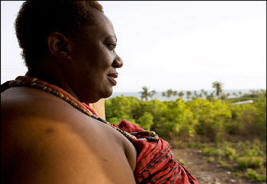
As the first female ruler of Otuam, Ghana, Peggielene Bartels has had to deal with a legacy of corruption -- and no shortage of sexism. Photo: Washington Post
How a Washington secretary became the first female ruler of Otuam, Ghana Eleanor Herman Washington Post March 14, 2010 [This article illustrates how little local officials did for the public with the money they collected.]
Corruption undermining justice in many countries, Transparency International says BBC News May 24, 2007 (You will leave this site.) Link to TI's Global Corruption Report 2007: Corruption in Judicial Systems
Pay for little or no work. Another concern is that government officials receive pay without delivering (often anything near) an adequate level of services. What they have done is support the current political system, not deliver government services.
Allocation of resources. The government frequently allocates resources, such as land and other natural resources such as oil, and and business opportunities, directly to itself and its supporters.
A very large part of this allocation/corruption is diversion of revenues from goods exported from or imported to the country.
The big ticket item is natural resource exports, including oil. One would think that discovering oil and being able to export it would enable governments in developing countries to provide sufficient resources for assisting poor people in that country to have education and health services and to provide productive employment. NOT! In fact what HN has described as harmful economic systems mean that very little---a token amount-- gets to poor people. (See resource curse Wikipedia especially the corruption section for further information.)

An aerial shot of a palm oil plantation on Sumatra Island. Photo: Jefri Aries/IRIN
Indonesia: Demand for palm oil fuels land-grabbing IRIN July 6, 2010
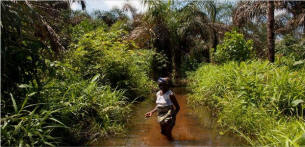
Hannah Baage walked through polluted Gio Creek in Kegbara Dere. She said recently, “There is Shell oil on my body.” Photo:Jane Hahn/New York Times More Photos
Half a world from the Gulf, giant oil spills have occurred every year for the past 50 years in the Niger Delta Adam Nossiter New York Times June 16, 2010 See Hunger Notes special report: Harmful economic systems See Hunger Notes special report Environment and hunger
Sonangol (the Angolan oil company), its director-general, and his looting of Angola's oil revenue Rafael Marques de Morais Pambazuka News June 15, 2010 Angola: Oil wealth no benefit to farmers IRIN News May 28, 2010
Zimbabwe's diamond production draws scrutiny by World Diamond Council for human rights abuses by Zimbabwe's army and police, who also take the lion's share of profits from diamond production Sarah Childress and Farai Mutsaka Wall Street Journal September 14, 2009
9 hostage officers killed at Peruvian oil facility--Amazonian Indians demand that Peruvian president withdraw decrees that ease the way for companies to carry out major energy and logging projects in the Amazon Simon Romero New York Times June 6, 2009
Zimbabwe vice-president seeks to sell 4 tons of Congo gold Grant Ferrett BBC News February 24, 2009

Inflation and currency devaluation Though neither inflation nor currency devaluation are necessary a sign of the government obtaining resources to promote its own interests, both can be. Large deficits (governments spending much more money than they take in typically lead to both inflation and devaluation, and is frequently due to government desire to control resources.
Venezuela to devalue its currency BBC News January 8, 2010 After currency devaluation, Chavez warns businesses that he will nationalize those that raise prices Reuters New York Times January 10, 2010
Use the government to maintain, consolidate and increase sources of income that are (apparently) obtained in other ways. This is more difficult to understand. Slavery would be an important and relatively clear example. The slave-owner is able to obtain an increased income from his slave's labor. This income is not income from the government. Nonetheless, a government--the United States before the Civil War, for example--is necessary to maintain a legal, administrative and police/military structure to permit and enforce slavery.
Land ownership would be another key example. In many countries there is highly unequal distribution of land. This ownership is typically derived from a period of conquest where land ownership was based on military force or other aspects of power. Land ownership, in spite of the passage of many years, has continued in a highly unequal fashion, essentially due to the continuance of highly unequal access to sources of power and wealth.

Workers loaded sugar for delivery last month at Hacienda Luisita, a Philippine plantation that is owned by the family of former President Corazon C. Aquino. Photo: Jes Aznar/New York Times
One sugar plantation--owned by the family of ex-President Aquino--illustrates the contentious path of land reform in the Philippines Norimitsu Onishi New York Times March 14, 2010 See Hunger Notes special report: Harmful economic systems
Forms of slavery--now without a strong basis in law--has continued to this day. In the present, a key term is "forced labor." An invaluable International Labor Organization report, Forced Labor describes the various types of forced labor. More than 12 million are trapped in forced labor worldwide. ) Certainly other aspects of society such as religion, prejudice, or 'scientific thinking' can reinforce the governmental role. For example, the Indian caste system is a system of stratification of human beings, with the Dalits or untouchables being the lowest caste, and this system has a strong religious component, as well as also being sustained by the people that benefit from the system (Wikipedia Dalit, Caste system in India).
All harmful economic activity is not managed by the government or by groups that control or enjoy benefits from the government. There are also other groups that undertake harmful economic activity. This can result in conflict between these groups, typically with great harm to ordinary people living in the conflict zones. Examples would be Sudan, Somalia, the Democratic Republic of the Congo, and the states in Mexico that are contested between the Mexican government and drug organizatins.
Drug cartels are a very important subset of "private enterprise" harmful economic activity where activities such as bribery, intimidation and murder are frequently employed.

Workers secure ropes around a mine shaft in Taxco, Mexico, where dozens of bodies were found in a mass grave, victims of drug wars. Photo: Margarito Perez/Reuters
Mass grave in Taxco, Mexico, (a popular tourist destination) is largest discovered in violent drug wars William Booth June 24, 2010 Drug gangs kill three in two attacks on US officials and their families in Ciudad Juarez Marc Lacey and Ginger Thompson New York Times March 14, 2010 Fearing drug cartels, reporters in Mexico retreat Marc Lacey New York Times March 13, 2010. El Paso and Ciudad Juárez, border towns on each side of the Rio Grande, are worlds apart in violence caused by drug importation to the United States Dan Barry New York Times February 13, 2010. See the New York Times series 'War without borders' on drug trafficking between Mexico and the United States.
Armed groups can fight with the government for control of territory, such as in Colombia, Pakistan, or the Democratic Republic of the Congo. Other countries can also be involved as in the Congo.
At least 6.8 million people were displaced last year, mainly by long-running conflicts, pushing the number of those forced to live away from home to 27 million - the highest since the mid-1990s IRIN News May 28, 2010
Even a government that to some degree supports ordinary citizens and their rights can be outmaneuvered by others, such as powerful government officials and landlords and others with economic power. Or governments can simply look the other way and acquiesce to wrongdoing.
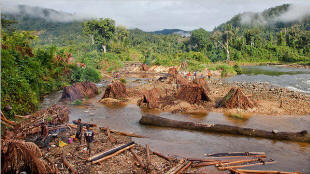
Loggers at Masoala National Park. In the past year, the illicit trade in a scarce species of rosewoods has increased at least 25-fold. Photo: Toby Smith/Reportage by Getty Images
Shaky rule in Madagascar threatens trees Barry Bearak New York Times May 25, 2010 See Hunger Notes special report: Harmful economic systems

Raimundo Teixeira de Souza held the residents’ card of his stepson who was killed, probably in a land dispute. Teixeira de Souza was forced to sell his land for a pittance to more powerful farmers, who roam this Wild West territory with rifles strapped to their backs. Photo: André Vieira/New York Times
Land grabs widespread in lawless Amazon region of Brazil--government now trying to impose greater order Alexi Barrionuevo New York Times December 26, 2009
Crime and looting are examples of harmful economic activity in which poor people can participate. Crime, frequently a terrorist activity--using terror to obtain income ("your money or your life")--happens everywhere. Even legitimate governments such as in the United States typically deal only partially with crime. Many neighborhoods in the United States are subjugated to gangs that sell drugs, kill people, and maintain control of their activities through intimidation and murder. This is frequently even more true in developing countries. Not only neighborhoods, such as Brazilian favelas, but also broad areas of a country can fall under the control of groups that essentially use force and intimidation to maintain control, though they may set forth an ideological justification for their actions. Colombian paramilitaries are an example.
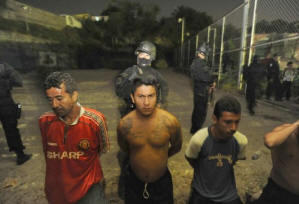
Gang suspects are arrested in a suburb of San Salvador. Gang violence is one
factor in the country’s homicide rate, one of the world’s highest. Slayings
averaged almost 12 a day in the first three months of this year. Photo Jose
Cabezas / AFP/Getty Images
El Salvador grapples with rising bloodshed--per capita homicide rate is 10 times US Tracy Wilkinson Los Angeles Times May 13, 2009
Armed killings cost nations billions of dollars each year, UN-Swiss study says Elaine Engler Associated Press/Denver Post September 12, 2008 See study executive summary and main webpage.
The Somali pirates have been an interesting new development in private harmful economic activity, which very possibly caused by fishing fleets from various developed countries fishing illegally in Somali waters and depriving coastal Somalis of their livelihood. Behind the bare brick walls of a desolate former British colonial prison, five jailed Somali pirates didn't seem very fearsome at all. Anarchy in Somalia has not only meant pirates but also vessels from countries such as France, Spain, Indonesia, and South Korea illegally gobbling up hundreds of millions of dollars' worth of fish from Somali waters, leading to destitution among Somali fisherman, and consequently piracy Shashank Bengali Christian Science Monitor May 5, 2009 Piracy symptom of bigger problem: Somalis have faced hunger and violence for many years BBC News April 15, 2009 Somalia: Inside a pirate network IRIN News January 13, 2009
A high level of "private enterprise" violence can lead to the desire for a more authoritarian government, a government that may restrict personal freedom, but also provides a more orderly society. As crime increases in Kabul, so does nostalgia for Taliban Pamela Constable Washington Post September 25, 2008 (You will leave this site.)